

“Milk!”
My daughter is nearly two, and that one word is doing an enormous amount of work.
At four in the afternoon it means she’s hungry. So we skip the bottle and make actual food, because formula at that hour just takes the edge off and ruins dinner. At nine at night, standing by the front door having just been told nobody is going outside, the same word (in tears and screams) means something else entirely. She needs a bottle in her hands to get herself back under control. An empty bottle is genuinely fine.
Same word, two completely different requests.
Her grandma came to stay recently and I left her a note. Nap time, what she eats, emergency numbers, the fact that she’ll ask for milk.
Everything on that note was true. I still got a message that evening: she keeps asking for milk and she won’t drink it.
That’s a handover. Someone competent, someone willing, holding a document that is entirely accurate, standing in a room where an accurate document isn’t enough. And the grandma was only there for a weekend. Your successor gets the job for three years.
Rotation is a choice, and someone pays for it
Companies move people on purpose, and for good reasons: breadth instead of narrow specialists, nobody becoming irreplaceable, no time for cosy arrangements with suppliers to set.
The bill lands on knowledge. Procedures survive a handover. Forms, numbers, logins, the org chart — all fine. What doesn’t survive is the part that decides whether you’re any good at the job:
- Where your discretion actually ends, as opposed to where the policy says it ends
- How exceptions really get resolved
- Who to call, in what order, and when not to put it in writing
Japan is where this is most visible. It’s a seasonal event: a certain portion of the people on your floor change teams in the same week each spring, and everyone knows it’s coming. But it is actually an universal problem. American service members have long relocated every two to three years — long enough to get good at the job, not long enough for anyone to benefit from it twice.
Then we connected an AI to it — nothing changed
None of this is news. Nonaka named this in HBR in 1991: the master craftsman has the skill at his fingertips and can’t tell you the principles behind it. So we built manuals, handover templates, wikis, knowledge management departments, lessons-learned databases. Every one of them politely asking experts to write down what they know, addressed to people who cannot see what they know. Then we wired an AI to the document store.
And at the desk, nothing moved. People are still calling their predecessors.
The reason is structural. The document store contains precisely the knowledge that was already surviving handovers. That was never the missing part.
Clarifeye gets it out of their heads
Nobody fills a blank page. Everybody answers a question.
Ask an expert to document their process and you’ll get the procedure, because the procedure is the part they can see. Ask them why did you decide it that way and you get the criterion — the thing that actually governs the decision, which they’ve never articulated because nobody ever asked.
So that’s what we built. Our AI agent Clara plans and runs series of interviews at scale, lets people stop halfway and pick it up later, and takes voice when typing isn’t realistic. It runs continuously, in campaigns — not in the fortnight after someone resigns.
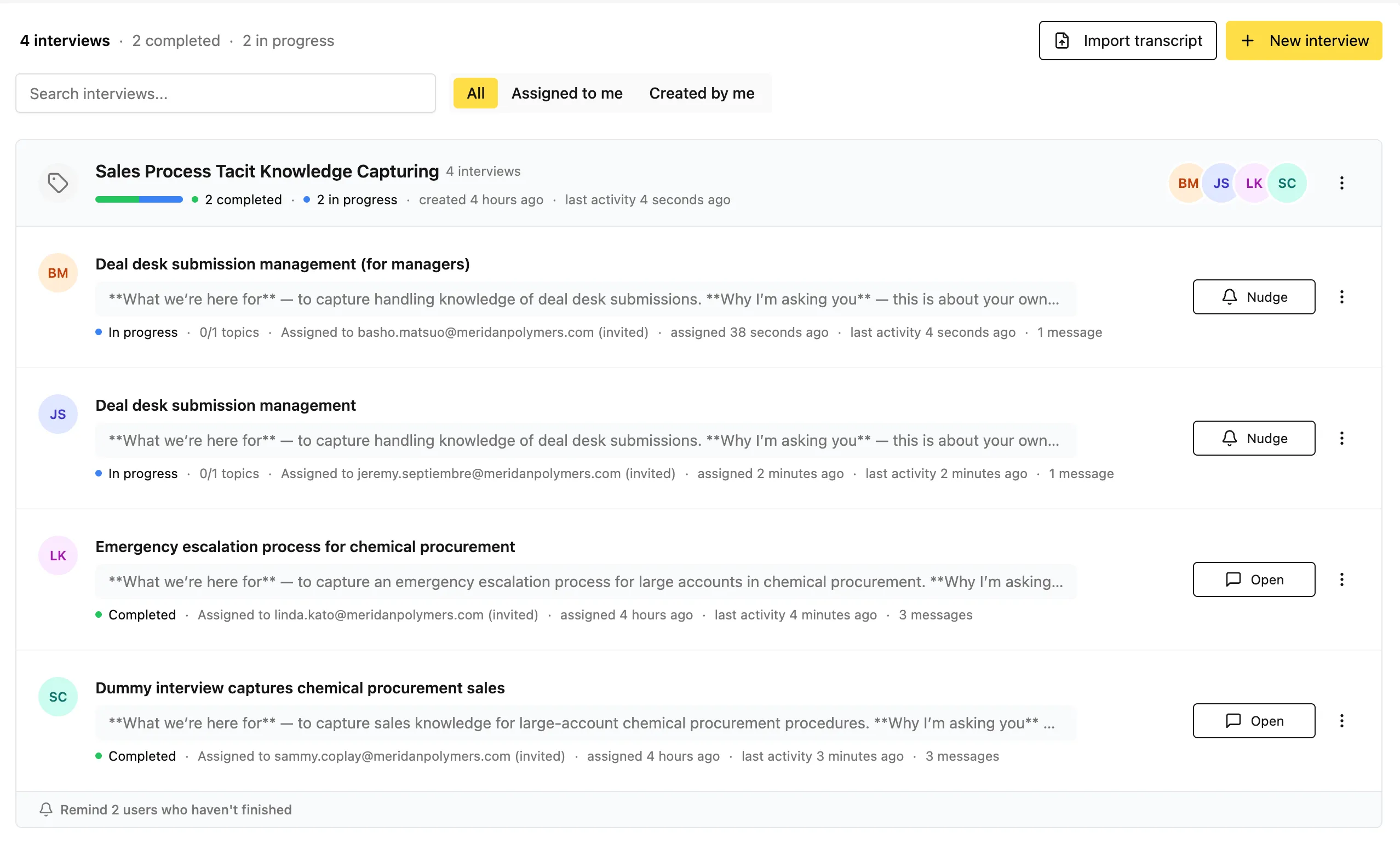
Interviews run continuously, in campaigns, not in the two weeks after someone resigns.
But the interview is just half of it. A folder of transcripts is a wiki with worse search. So Clarifeye turns it into a structure a machine can walk through: process maps, mental maps, playbooks, decision criteria with the reasoning still attached, and the source — who said this, and when.
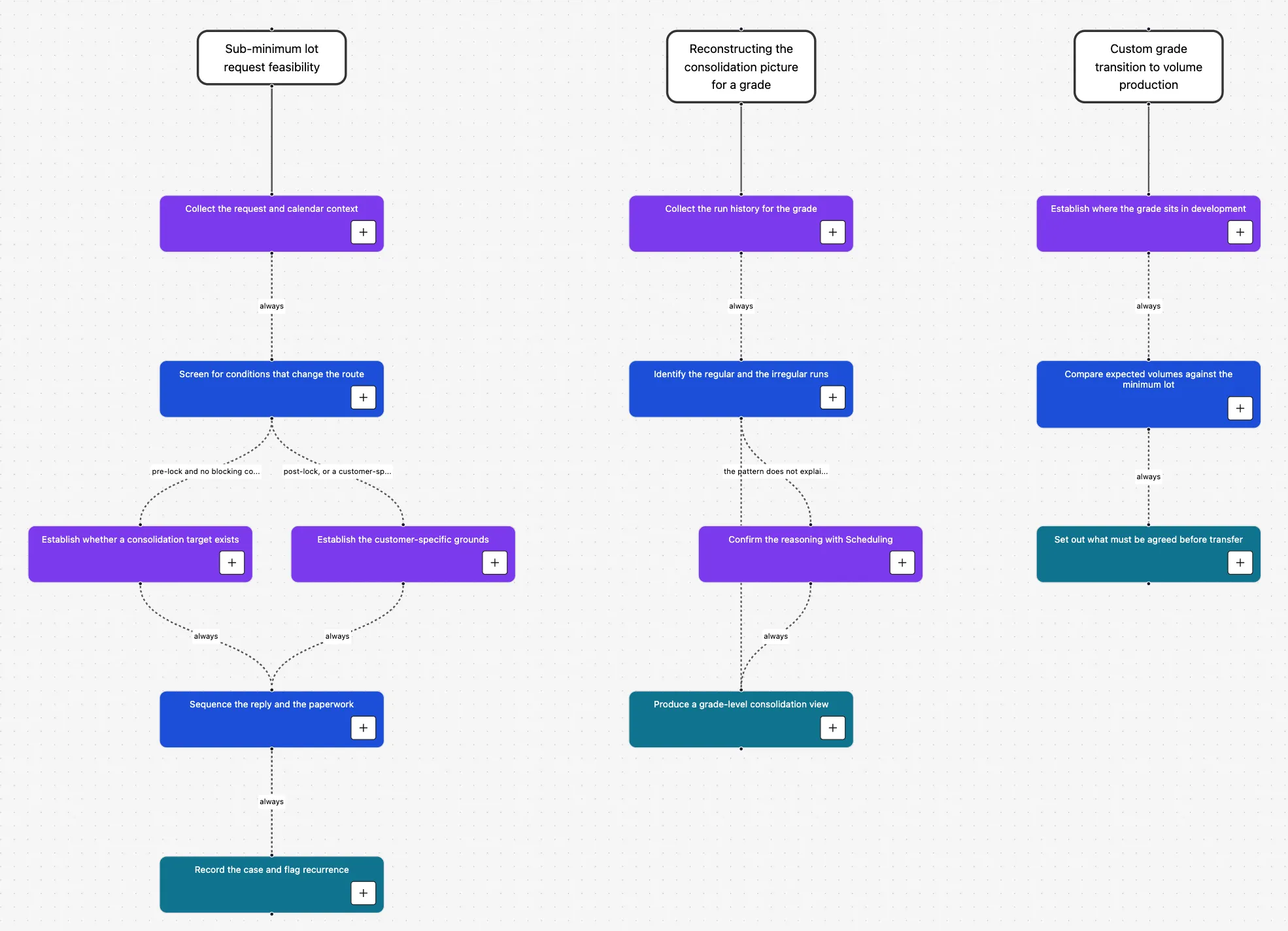
The reasoning chain gets captured in a structure the AI can actually read.
Your assistant stops searching documents. It gets something it can reason over.
Same question, both assistants
Here’s a real one. A technical sales rep, two weeks into the role, gets asked for two tonnes of a compound with a five-tonne minimum lot. He asks the company’s AI assistant. Then he asks the same question again, with Clarifeye connected.
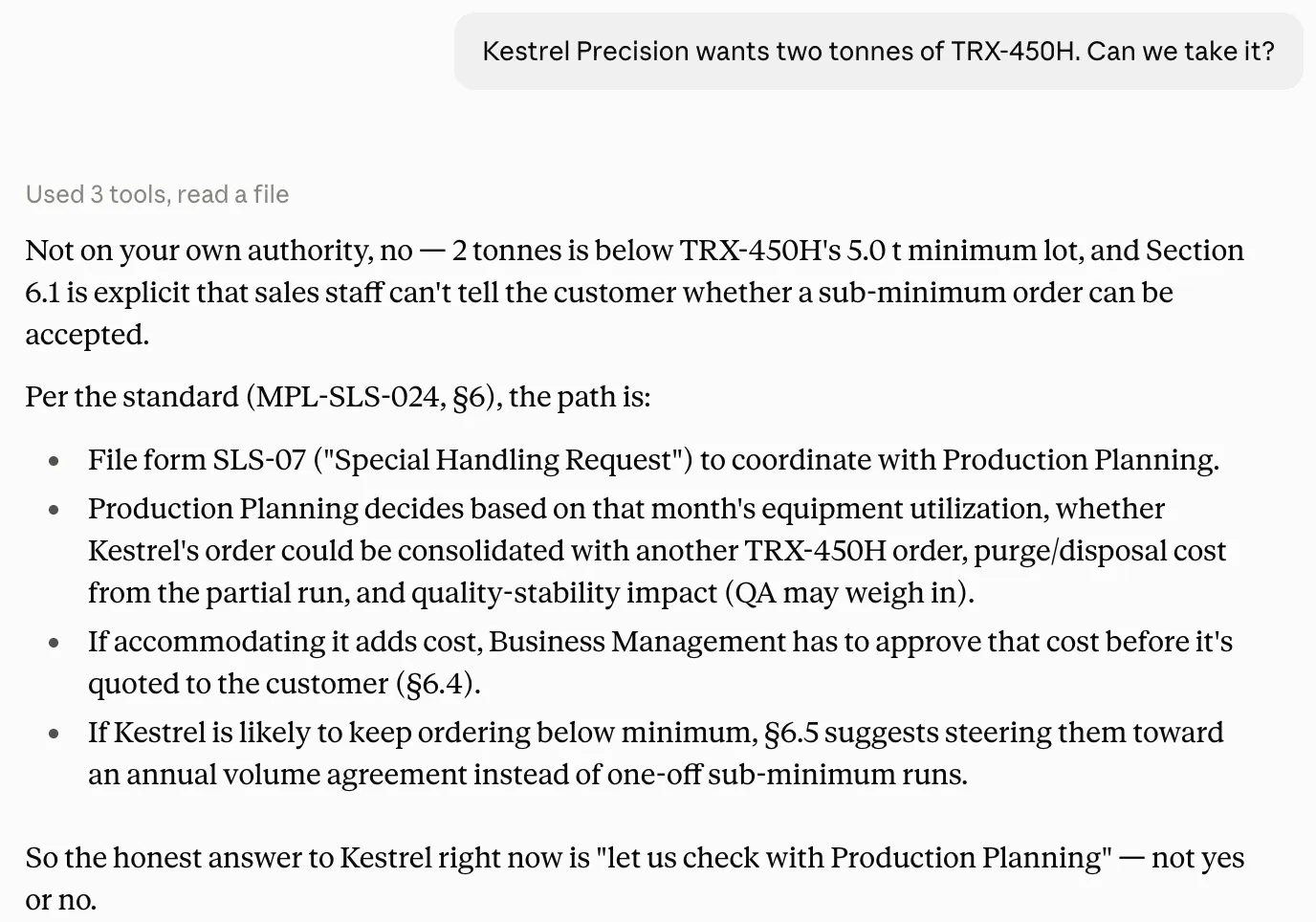
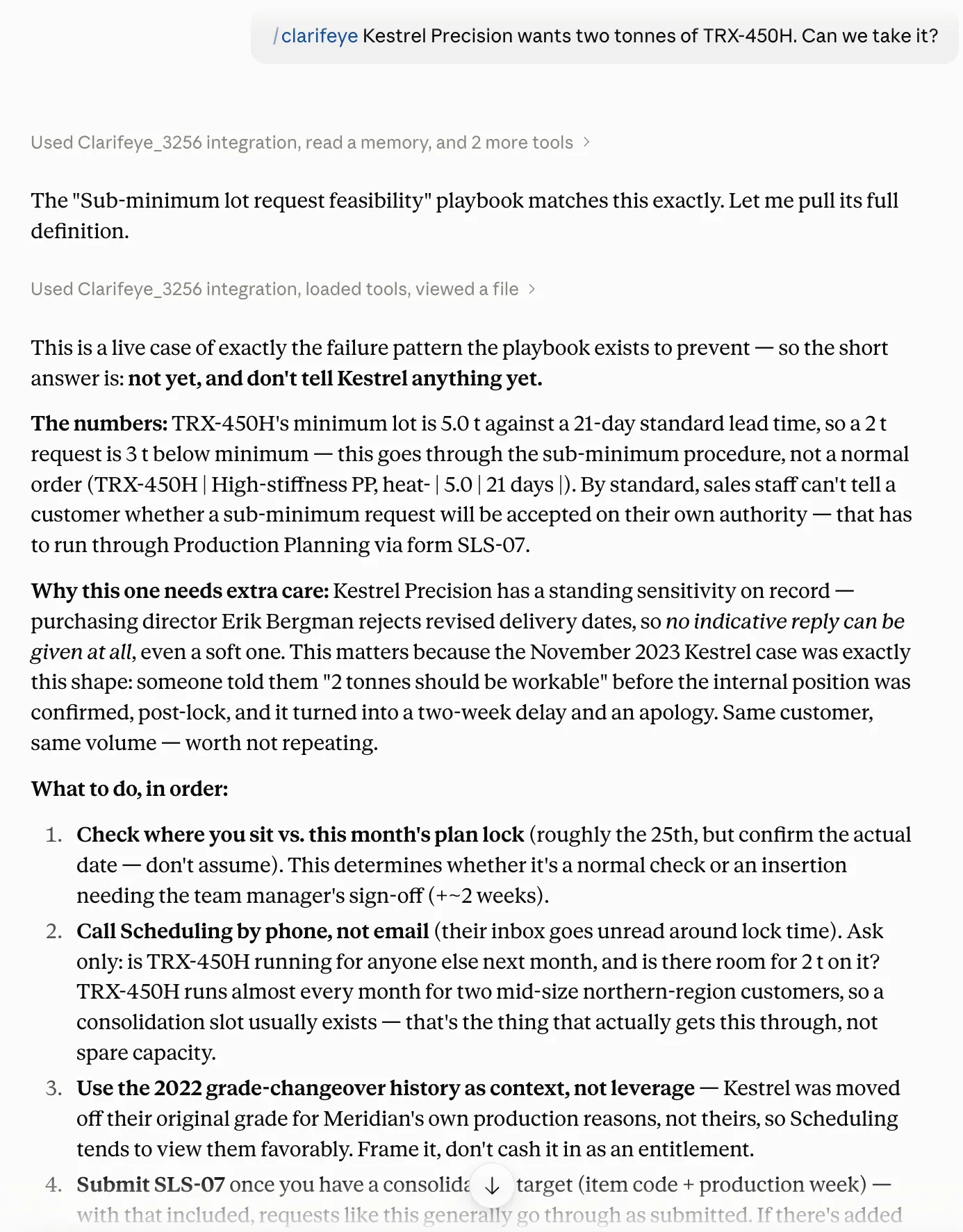
Left: connected only to the document store. Right: also connected to Clarifeye.
The answer on the left is correct. Right clauses, right order, the form he needs, and it sensibly declines to promise the customer anything. Nothing in it is false.
It just misses the thing that decides the outcome: the production plan locks around the 25th. Before that, two tonnes joins a run that’s already scheduled. After it, the same request costs two weeks — which is what happened to this customer in November 2023. The assistant on the right leads with that, and says phone, not email.
Same model on both sides. The only difference is what’s underneath.
And notice what makes the left-hand answer dangerous: it isn’t wrong. Nobody double-checks an accurate answer. Her grandma gave her milk, and she was right to, and it didn’t work.
Handover stops being an event
You arrive and the questions you’d have phoned someone about have answers, with reasoning attached. Not a folder. Answers.
You’re in the role and your own judgement gets captured as you go — the exception you handled in March, the workaround that turned out to be a bad idea.
Your transfer comes through and there’s no scramble, because writing the handover is now a review of something that already exists.
Your successor arrives on top of your knowledge plus your predecessor’s, rather than at the bottom of the hill again.
None of this replaces handover documents. Keep writing them. This holds what they never could.
Move the people. Leave the knowledge.
Rotation works. The handover note wasn’t the problem either. Thinking the note was enough was.
So: when do you stop calling your predecessor? When the organisation can answer in their place.

An empty bottle is genuinely fine.